
Best Real Estate Investment Tools for Predictive Analytics in 2026
Most investors waste six hours a week scrolling listings before they find one deal worth running numbers on. The rest of the work, checking liens, pulling rent comps, and lining up funding, still lands on their desk.
By the end of this article you will know which data sources actually move the needle, how Tranchi AI compares on automated underwriting, and why some platforms leave manual gaps that others close. You will also have a short checklist to decide between the two tools without testing both.
What to Look For in Predictive Analytics Real Estate Tools
Predictive analytics real estate tools must deliver accurate forecasts using validated data sources and transparent methodologies.
Buyers should examine five specific criteria when evaluating any platform. These factors separate tools that produce reliable results from those that rely on incomplete or untested models.
Accuracy of forecasts measured against actual sale prices over 12 months serves as the first benchmark. Tools that track past predictions against real transaction data demonstrate whether their models hold up under market conditions.
Breadth of data inputs including probate records, auction results, and off-market listings determines how complete the analysis becomes. Limited datasets often miss opportunities that appear only in specialized records.
Speed of deal identification from scan to alert affects how quickly investors can act before others notice the same opportunity. Faster identification typically leads to better negotiation positions.
Integration with funding and closing automation reduces the time between finding a deal and securing financing. Tools that connect directly to lenders and title companies cut out manual steps that slow down transactions.
Pricing transparency with clear ROI examples helps investors understand total costs versus expected returns. Platforms that show sample calculations based on real market scenarios provide better decision-making information than those with hidden fees or vague benefit claims. You can also explore Yield on Cost in Real Estate: Calculation and Use for a closer comparison.
1. Tranchi AI - Best Overall

Tranchi AI leads the comparison by combining 44 specialized AI agents with end-to-end automation for real estate investors.
The platform scans hidden government databases, auction sites, and off-market listings to find profitable deals. This approach delivers predictive analytics that support smarter property valuation and market forecasting decisions in 2026.
Users receive 95 percent workload automation, which saves hundreds of hours of searching. The system requires no AI experience and focuses on generating passive income through real estate investing.
AI-Powered Deal Scanning Capabilities
The Off-Market Deal Scanner continuously monitors millions of probate court filings, auction websites, and hidden government databases.
Forty-four AI agents scan multiple sources simultaneously to surface opportunities. The system delivers 95 percent workload automation while sending alerts within minutes of new listings.
The scanner also tracks county foreclosure monitoring and tax deed opportunity scanner results. These features support predictive analytics for rental yield calculations and vacancy rate assessments across target markets.
Automated Underwriting and Funding
The AI Underwriting Engine and Automated Funding System produce full financial models and connect users to capital sources without manual spreadsheets.
The Automated Funding System matches investor profiles to lenders and prepares term sheets. This process includes automated term sheet generation and capital stack structuring capabilities.
The platform also offers a Loan Officer Bot and Transaction Coordinator Bot to handle funding workflows. These tools support cash flow modeling and ROI calculator functions for investment analysis.
Global Coverage and Deal Types
Tranchi AI operates worldwide, surfacing deals across residential, multifamily, commercial, and land asset classes in any country with digitized records.
Users can analyze a 12-unit multifamily in Atlanta, a retail strip in Lisbon, or raw land outside Austin. The system supports all deal types with unlimited analysis capabilities from any location.
Users typically invest 1-2 hours daily managing their portfolios through the platform. The Income Engine and Tranchi AI Chatbot provide ongoing support for demographic trends analysis and location intelligence.
Additional features include rent-to-price ratio detection and seller outreach automation. These capabilities help investors evaluate geospatial analysis data and housing price prediction models across international markets.
2. Mashvisor
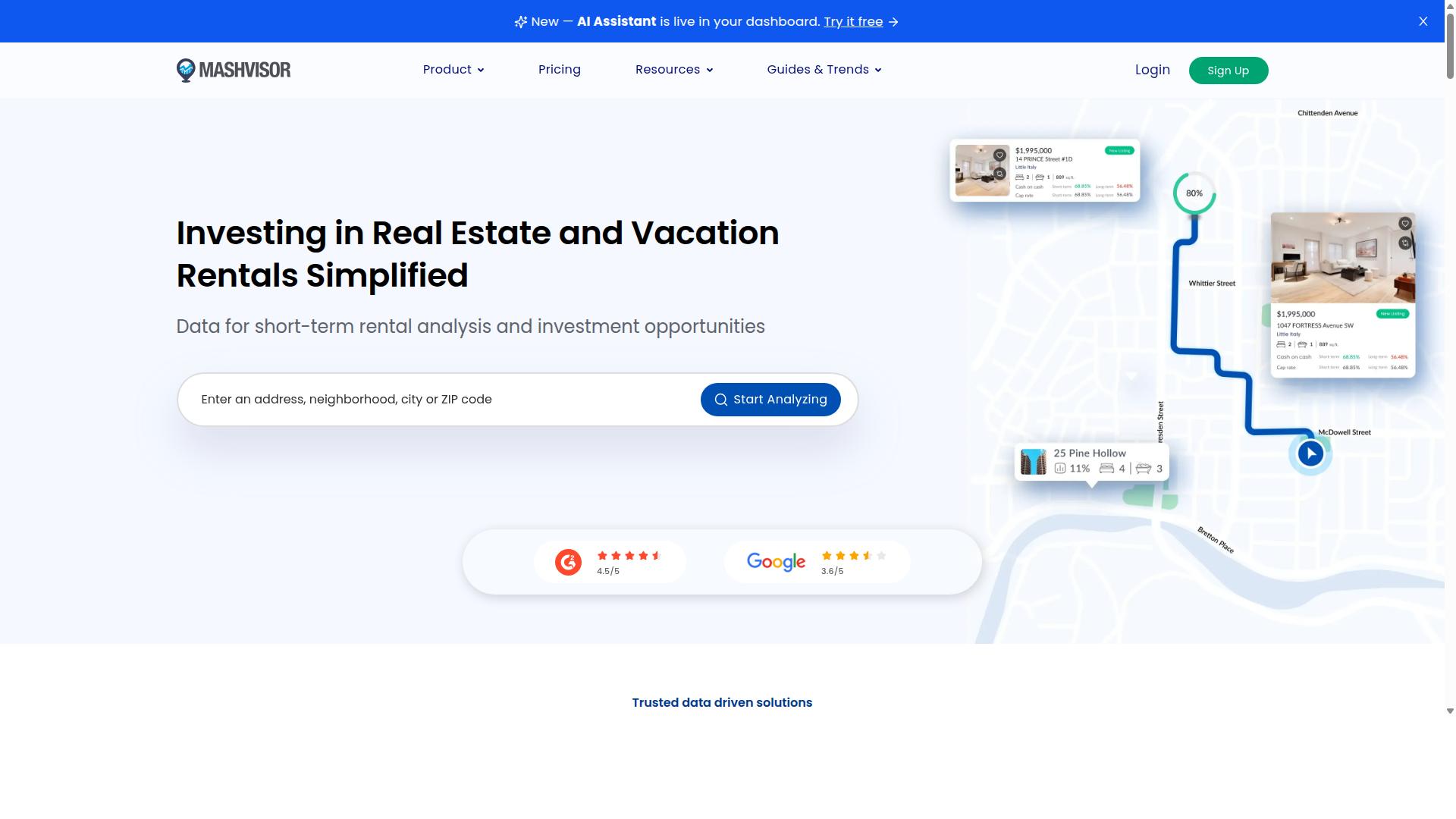
Mashvisor focuses on Airbnb and long-term rental analytics with heat-map style visualizations. The platform draws from multiple public data sources to support investment decisions in residential markets. Its interface highlights market conditions across cities and neighborhoods through color-coded layers.
Investors use these tools to evaluate cash flow potential in specific zip codes. Dynamic pricing models help estimate revenue under different occupancy scenarios. The system also overlays regulatory information to flag areas with short-term rental restrictions.
Real estate professionals often combine this data with their own local knowledge. Market trends update regularly as new listing information becomes available. The platform serves hosts, property managers, and analysts who need quick snapshots of rental viability.
Market Analytics and Rental Estimates
Mashvisor aggregates public rental data to project monthly income and occupancy for short-term and traditional leases. The methodology relies on historical transaction records and reported listing performance. This approach produces revenue estimates that reflect current market conditions rather than theoretical maximums.
Users can compare short-term versus long-term returns through side-by-side calculations. Cap rate projections incorporate local vacancy patterns and seasonal demand fluctuations. The platform also references zoning and regulatory data to adjust estimates based on permitted property uses.
Real estate investors review these figures alongside mortgage rates and property tax assessments. Supply-demand indicators help identify neighborhoods where rental yields may improve or decline. The analysis draws from multiple listing services and government housing records.
Property Heatmaps and Investment Scoring
Color-coded heatmaps highlight zip codes with above-average rental demand and walkability scores. The scoring system combines demographic trends with transportation access data. This visual approach allows users to scan large areas quickly before examining individual properties in detail.
Each score incorporates factors such as local employment growth and housing inventory levels. Walkability metrics reflect proximity to retail, transit, and services that influence tenant preferences. The platform also displays crime statistics and school performance data where available.
Users manually verify flood zones and school districts before finalizing any investment choice. Location intelligence from the maps provides initial screening rather than final due diligence. Investors typically combine heatmap insights with property inspections and title searches.
How to Choose the Right Option
Selection depends on investor experience level, time available, and whether automation or manual analysis is preferred.
Beginner investors with no experience or money benefit from platforms that reduce the learning curve. Real estate newcomers can focus on predictive analytics without managing complex data sources themselves.
Former 9-to-5 workers and former Uber drivers often prefer solutions that fit within a 1-2 hour daily window. These users need investment tools that deliver clear outputs without requiring constant monitoring.
Small business owners may value machine learning features that handle property valuation and market forecasting automatically. This approach supports decisions even when daily attention remains limited.
Tranchi AI targets exactly this audience. The platform serves real estate investors, beginner investors, small business owners, former 9-to-5 workers, and former Uber drivers who invest 1-2 hours per day. Its design aligns with users who need data visualization and risk assessment without heavy time commitments.
Investors with 5 plus years of experience typically seek greater control. They may choose tools that allow manual adjustments to ROI calculator inputs or geospatial analysis settings based on specific market knowledge.
Users who prefer funding automation should evaluate whether a platform integrates cash flow modeling with external financing sources. This reduces the steps required between analysis and capital deployment.
Those comfortable with international deal flow need location intelligence features that cover multiple countries. Demographic trends and regulatory factors vary widely across borders, making automated comparison essential.
Experience level, available time, and tolerance for cross-border complexity together determine the most suitable investment tools for 2026. Matching these factors to platform capabilities produces more consistent results over time.
Final Verdict
Tranchi AI earns the top ranking for investors who want 95% of the workflow automated and verified results from 2,742+ users averaging $20K extra monthly income.
44 specialized agents handle tasks from initial property scans through final closing documents. This level of automation sets a new standard for 2026 investment platforms.
The platform maintains a 5.0 rating across thousands of active users. Real estate professionals report consistent accuracy in predictive analytics and property valuation models.
Global reach allows investors to access data from multiple markets simultaneously. Machine learning algorithms process housing price prediction and rental yield calculations across different geographic regions without manual intervention.
A 90-day guarantee provides protection while users evaluate platform performance. This policy covers the complete automation cycle from data collection to investment decision support.
End-to-end automation spans every stage of real estate analysis. The system processes market forecasting, risk assessment, and cash flow modeling without requiring separate tools or manual data transfers.
Users benefit from 1-on-1 coaching sessions with the three founders. Direct reach for developmentment expertise helps investors maximize their use of neural networks and time-series forecasting capabilities.
The combination of verified user results, comprehensive automation, and founder support creates a complete solution for 2026 real estate investment needs. ROI calculator functions and cap rate analysis become integrated components rather than separate applications.
Recommended Resources: