Housing, land and place in Austin

A notebook of explainers on how a local housing market works

What actually moves a local housing price

Market mechanics · long explainer · about twelve minutes

A housing price is an outcome, not an input. It is the number at which one particular building, on one particular lot, found one particular buyer who was able to borrow or pay it on one particular week. Everything usually described as moving the market is really something that changes how many such meetings happen, and on whose terms.

Four forces do most of that work. The first is standing supply: how many homes are available at once, measured against how fast they are being absorbed. When a market holds two months of unsold supply, buyers make decisions in days and concede terms in order to be chosen. When it holds eight, sellers begin conceding instead, and they concede on repairs and timing long before they concede on the headline figure.

The second is the cost of borrowing, which matters far more than most listing conversation admits, because most purchases are financed. A change in prevailing rates does not change what a house is; it changes the monthly amount that a given payment will support, and therefore the price a given household can reach. This is why prices and rates can move in the same direction for a while and then sharply diverge, and why the number of transactions usually reacts to rates faster than the prices do.

The third is household formation: how many new households are being made in a place, by arrival, by separation, by people leaving a shared arrangement. Population change alone is a poor guide, because a thousand people arriving as three hundred households is a very different pressure from a thousand arriving as nine hundred. The fourth is friction, and it is the one people forget. Selling a home costs real money and several weeks of attention, so owners who might otherwise move simply do not, and the supply that theoretically exists never appears.
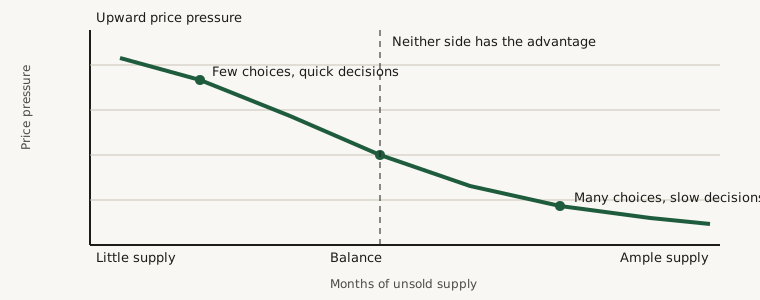
Line diagram showing price pressure falling as months of unsold supply rise, with a dashed balance line near the middle
Months of unsold supply against price pressure. The shape matters more than any particular point on it: the curve is steep at the scarce end, which is why small changes in listings produce large changes in behaviour when supply is already thin, and why the same change barely registers when supply is ample.

Read the full explainer →

Also in this notebook

Buying, stage by stage

Transaction mechanics · explainer

A purchase is not one decision but a chain of conditional ones, and each link can end the chain. Setting a budget comes before searching, because the search reshapes the budget if it goes first. The stages after an accepted offer are mostly verification: of the building, of the value, and of the ownership itself.

Read the full explainer →

Selling, stage by stage

Transaction mechanics · explainer

Almost every decision that determines how a sale goes is made before the property is ever exposed to buyers. Pricing is a claim about comparable evidence rather than a wish, and the market answers it within a few weeks. What follows is the management of contingencies rather than persuasion.

Read the full explainer →

What a survey and a title search actually check

Land and records · explainer

A property has a physical existence and a legal one, and the two are documented separately. A survey answers where the lines are and what crosses them; a title search answers who may convey it and subject to what. Easements, setbacks and encroachments live in the gap between those two answers.

Read the full explainer →

Mortgages in plain terms

Money · explainer

A mortgage is an amortisation schedule with a lien attached, and nearly everything confusing about it follows from that. The quoted rate is only one input into the cost; term length, structure and the escrowed items all move the monthly figure. This page explains the machinery in general, and recommends nothing.

Read the full explainer →

Renting against owning

Market mechanics · explainer

The question is usually posed as though one tenure were simply better, which is why it rarely resolves. The honest comparison is between carrying cost plus transaction cost spread over an expected holding period, and rent. The rest of the difference is about liability, mobility and control, and does not reduce to arithmetic.

Read the full explainer →

How a county appraisal becomes a tax bill

Land and records · explainer

Two different things are called an appraisal, and confusing them causes most of the misunderstanding here. A taxing appraisal is a mass valuation, produced by an appraisal district on a calendar, not a negotiated opinion. Rates are then set separately by several jurisdictions and applied to that value.

Read the full explainer →

Where to read further

  • Glossary of housing termsAbout thirty plain-language definitions, cross-referenced into the explainers.
  • Neighborhood indexHow the river, the rail line and the interstate shaped where the districts are.
  • East AustinA planning boundary that became a housing boundary, and the stock it left behind.
  • Hyde ParkA late nineteenth-century streetcar plat and what its geometry still does to the housing.
  • South CongressA highway corridor read as a destination, and the residential blocks behind it.
  • Records a reader can consult directlyCounty clerk deed and plat records, appraisal district property records, and municipal zoning and permit maps are all public in principle; each is held by a separate office and each answers a different question.